-
Singleton Design Pattern
-
The Singleton Design Pattern is one of the most widely used creational design patterns in C# and modern software architecture. It ensures that a class has only one instance throughout the application lifecycle while providing a global access point to that instance.
This pattern is especially useful when dealing with shared resources such as logging systems, configuration settings, caching, and database connections. Understanding the Singleton Pattern is essential for writing efficient, maintainable, and scalable applications.
What is Singleton Design Pattern?
The Singleton Pattern is a creational design pattern that ensures only one instance of a class exists and provides a single global point of access to it.
Instead of allowing multiple objects to be created, the pattern restricts instantiation and returns the same instance whenever requested.
- Single Instance: Only one object of the class is created during the entire application lifecycle, preventing duplication and ensuring consistency.
- Global Access Point: The instance can be accessed from anywhere in the application, making it ideal for shared resources and centralized control.
- Controlled Object Creation: The class itself manages its instantiation, ensuring that no external code can create additional instances.
Structure of Singleton Pattern
The structure of the Singleton Pattern defines how the instance is controlled and accessed.
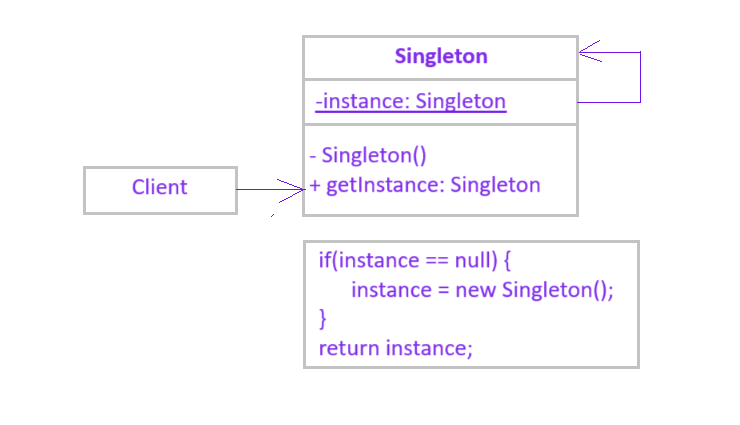
The key components involved in the structure are:
- Private Static Instance: A static variable that holds the single instance of the class and ensures it is shared globally.
- Private Constructor: Prevents external classes from creating new instances, enforcing strict control over object creation.
- Public Access Method: A method or property that provides access to the instance and creates it only when required.
Basic Singleton Implementation in C#
Let’s understand how the Singleton Pattern works with a simple implementation.
using System;

public class Singleton
{
    private static Singleton _instance;

    // Private constructor prevents instantiation
    private Singleton()
    {
    }

    // Global access point
    public static Singleton Instance
    {
        get
        {
            if (_instance == null)
            {
                _instance = new Singleton();
            }
            return _instance;
        }
    }

    public void ShowMessage()
    {
        Console.WriteLine("Hello from Singleton!");
    }
}
Usage
class Program
{
    static void Main()
    {
        Singleton singleton = Singleton.Instance;
        singleton.ShowMessage();
    }
}
Understanding How It Works
When the Instance property is accessed for the first time, the object is created. For all subsequent calls, the same instance is returned.
This ensures that memory is not wasted and all parts of the application operate on the same object.
- First Request: Instance is created and stored in memory.
- Subsequent Requests: Existing instance is returned.
- Result: Consistent behavior across the application.
Thread-Safe Singleton in C#
In case of multi-threaded applications, multiple threads attempts to create an instance at the same time, which can break the Singleton pattern.
To solve this, thread-safe implementations are required.
There are several approaches to implement thread-safe Singleton in C#:
- Thread Safe Singleton using Lock: Uses locking to ensure that only one thread can create the instance at a time, preventing race conditions.
- Thread Safe Singleton using Eager Loading: Creates the instance at application startup, ensuring thread safety without additional synchronization.
- Thread Safe Singleton using Lazy Loading: Uses built-in lazy initialization to create the instance only when needed in a thread-safe manner.
Each approach is useful depending on performance requirements and application design.
Real-World Analogy
A simple real-world example of the Singleton Pattern is the government of a country.
A country can have only one official government at a time. Regardless of how many people interact with it, there is always a single authority managing operations.
This government acts as a centralized access point, similar to how a Singleton instance works in software.
Common Use Cases
- Logging Systems: A single logger instance ensures that all logs are written consistently from one centralized location.
- Configuration Management: Application settings can be accessed globally without creating multiple configuration objects.
- Database Connections: A single connection manager helps control database access efficiently.
- Caching Systems: Shared cache instances improve performance and reduce redundant data processing.
- Application State Management: Maintains a consistent state across different parts of the application.
Key Benefits of Singleton Pattern
- Ensures a single instance: Guarantees that only one object exists, preventing duplication and maintaining consistency across the system.
- Optimizes memory usage: Reduces unnecessary object creation, which improves application performance and resource utilization.
- Provides centralized control: All operations related to the shared resource are managed from one place, simplifying system design.
- Improves consistency: Since all components use the same instance, data remains consistent across the application.
- Supports scalable architecture: Helps in designing systems that can grow without introducing unnecessary complexity.
Summary
The Singleton Design Pattern in C# is a powerful and essential pattern used to ensure that only one instance of a class exists throughout the application lifecycle.
It provides a global access point to shared resources, making it ideal for scenarios like logging, configuration management, and database handling.
By controlling object creation and maintaining consistency, the Singleton Pattern helps developers build efficient, scalable, and maintainable applications.
Mastering this pattern is crucial for writing clean, professional, and production-ready code in modern software development.