-
ASP.NET Core MVC Introduction
-
Modern web development offers many frameworks, but when the goal is to build structured, scalable, and search-engine-friendly web applications using .NET, ASP.NET Core MVC remains a powerful and reliable choice.
ASP.NET Core MVC is a web application framework in the .NET platform used to build dynamic, server-side rendered websites using C#. When a user requests a page, the ASP.NET Core application running on a web server (such as Kestrel or IIS) processes the request, executes the application logic, and generates the complete HTML before sending it back to the browser.
What Exactly Is ASP.NET Core MVC?
At a high level, ASP.NET Core MVC is a server-side web application framework built on the ASP.NET Core platform. It is designed to help developers build structured, UI-driven web applications using a clean architectural approach.
The term MVC stands for:- Model
- View
- Controller
MVC is not just a theory — it’s a practical way to keep web applications from becoming chaotic as they grow. In many poorly structured projects, UI code, data processing, and request handling end up tangled together. Over time, that makes changes risky and debugging painful. The MVC approach avoids that problem by clearly dividing how an application is organized and how different parts interact.
ASP.NET Core MVC applies this structure within the .NET ecosystem. When a user opens a webpage, the application running on the web server executes the required logic, prepares the data, and produces the final HTML output before it ever reaches the browser. The browser receives a completed page instead of building it piece by piece.
This difference matters. Because the markup is already prepared on the server, the content is immediately readable by search engines and faster to display for users. That makes ASP.NET Core MVC particularly strong for content-heavy websites, business platforms, and applications where clarity, performance, and long-term maintainability matter more than flashy client-side behavior.
Where ASP.NET Core MVC Fits in Web Development
To understand its role clearly, look at this comparison:
Feature ASP.NET Core MVC Client-Side SPA Frameworks Rendering Server-side rendering Client-side rendering SEO Support Excellent (HTML generated on server) Requires extra configuration (SSR or pre-rendering) Initial Load Speed Fast first load Often slower initially due to JS bundles JavaScript Dependency Minimal Heavy reliance on JavaScript Ideal For Content-driven and business applications Highly interactive and dynamic applications This makes ASP.NET Core MVC especially strong for:
- Business websites
- Blogging platforms
- Educational portals
- Corporate dashboards
- Enterprise management systems
How ASP.NET Core MVC Applications Work
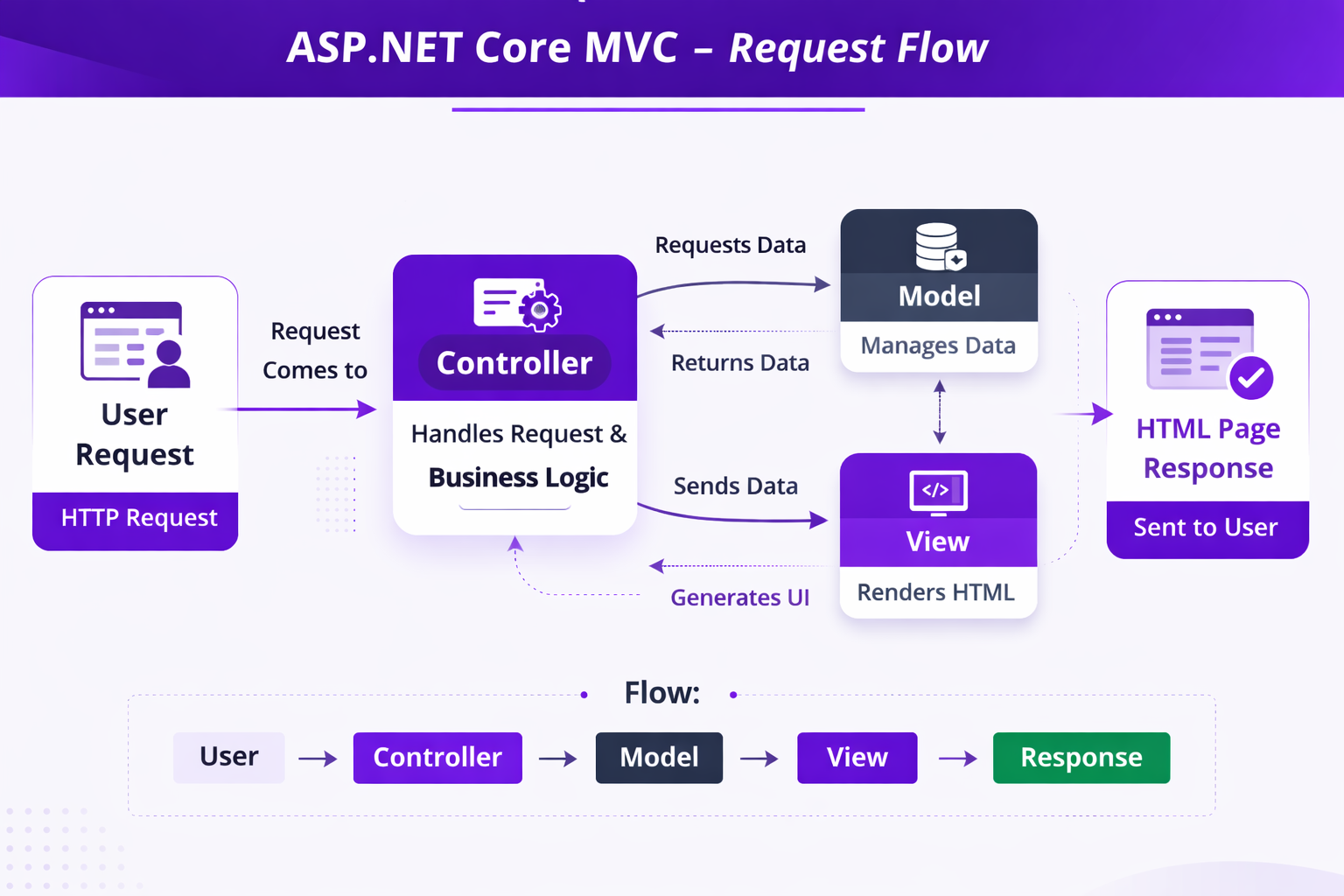
When a user accesses a webpage built with ASP.NET Core MVC:
- The browser sends a request to the server.
- The server processes the request using application logic.
- Data is retrieved if necessary.
- HTML is generated dynamically.
- The completed page is sent back to the browser.
Because the page arrives fully rendered, search engines can crawl and index it efficiently.
Developer-Oriented Strengths of ASP.NET Core MVC
1. Structured Project Organization
ASP.NET Core MVC promotes organized code structure. Applications are divided logically into folders such as:
- Controllers
- Models
- Views
- wwwroot
This structure improves long-term maintainability.
2. Dynamic UI Generation with Razor
ASP.NET Core MVC includes a templating system called Razor that enables developers to embed C# logic directly within HTML markup in a clean and readable way.
Example:@model Product <h2>@Model.Name</h2> <p>Price: @Model.Price</p>This allows server-side data to appear directly in the user interface without complex JavaScript manipulation.
3. Performance Advantages
ASP.NET Core is designed with performance in mind.
Performance Feature Benefit Asynchronous support Handles more concurrent users efficiently without blocking threads Lightweight runtime Enables faster execution and reduced overhead Efficient memory usage Improves scalability and optimizes resource consumption Built-in dependency injection Promotes cleaner architecture and easier maintainability For websites expecting high traffic, this matters significantly.
4. Built-In Security Capabilities
Security is integrated into the framework.
ASP.NET Core MVC supports:
- Authentication mechanisms
- Authorization policies
- Anti-forgery protection
- HTTPS enforcement
- Secure cookie handling
For enterprise-grade applications, these built-in features reduce development risk.
Real-World Scenario: Business Website
Imagine developing a corporate website.
Each page:- Is generated dynamically
- Pulls content from a database
- Includes SEO metadata
- Loads quickly
- Is indexed easily by Google
With server-side rendering, every page is search-engine ready by default.
This is particularly important if your monetization depends on organic traffic and ad networks like Google AdSense.
When Should You Choose ASP.NET Core MVC?
You should consider ASP.NET Core MVC when:
- SEO is a top priority
- You need server-generated HTML
- You are building structured business systems
- You prefer C# over JavaScript-heavy stacks
- Long-term maintainability matters
It may not be ideal if your application requires extreme client-side interactivity like a complex single-page application.
Cross-Platform Deployment
Applications built using ASP.NET Core MVC can run on:
- Windows servers
- Linux servers
- Docker containers
- Cloud environments such as Azure
This flexibility ensures modern deployment compatibility.
Is ASP.NET Core MVC Still Relevant Today?
Yes — very much.
Despite the popularity of frontend-heavy frameworks, server-rendered web applications continue to dominate:
- Content platforms
- Enterprise dashboards
- Corporate websites
- Internal business tools
Search engines still favor clean, fully rendered HTML — and ASP.NET Core MVC delivers exactly that.
For developers who want to build scalable and professional web systems using .NET, mastering ASP.NET Core MVC remains highly valuable.
Summary
ASP.NET Core MVC provides a structured, performance-oriented, and secure approach to building modern web applications with C#.
It combines:- Clean architectural principles
- Server-side rendering
- Strong typing
- Built-in security
- Excellent SEO compatibility
For developers aiming to create maintainable, scalable, and search-engine-friendly web applications, ASP.NET Core MVC continues to be a practical and future-ready solution.