-
.NET Core Architecture
-
Understanding .NET Core architecture is essential for building reliable, high-performance, and future-ready applications. Many developers confuse .NET Core architecture with ASP.NET Core architecture, but these two operate at different levels and solve different problems.
Lets clarify this distinction first, then we will understand .NET Core architecture from the ground up, focusing on how applications are compiled, executed, and managed at runtime.
.NET Core Architecture vs ASP.NET Core Architecture
Before diving deeper, it’s important to establish a correct mental model.
Aspect .NET Core Architecture ASP.NET Core Architecture Level Runtime and platform level Application and web framework level Focus Code execution, memory management, JIT compilation, garbage collection Middleware pipeline, routing, HTTP request/response handling Exists without web Yes, can run without any web components No, designed specifically for web-based applications Used for Console applications, background services, microservices, APIs Web applications and RESTful APIs Dependency Independent runtime Built on top of .NET Core .NET Core defines how applications run.
ASP.NET Core defines how web applications behave.Now that the confusion is resolved, lets focus on .Net Core Architecture
What Is .Net Core Architecture?
.NET Core architecture defines the runtime and platform layers that execute, manage, and optimize .NET applications across different operating systems.
It describes the layered structure responsible for:- Loading and executing application code
- Managing memory and garbage collection
- Performing Just-In-Time (JIT) compilation
- Abstracting operating system differences
- Enabling cross-platform, side-by-side, and cloud-ready execution
In essence, .NET Core architecture focuses on how applications run, not how requests are handled or user interfaces are built.
Frameworks such as ASP.NET Core operate on top of this architecture, while .NET Core itself provides the runtime and platform foundation.
High-Level .NET Core Architecture Overview
At a conceptual level, .NET Core is built as a layered system.
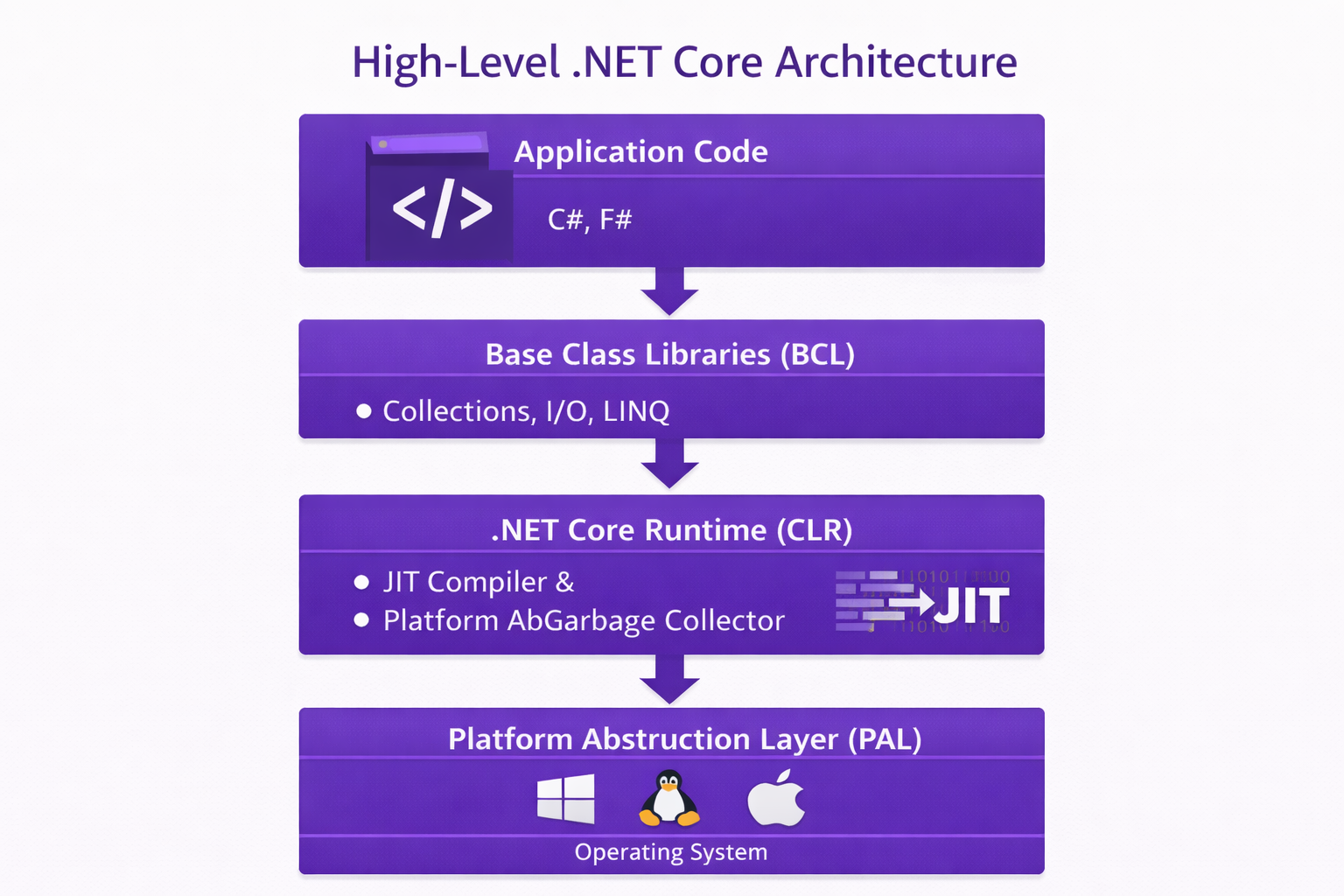
Each layer has a single, well-defined responsibility, which is why .NET Core scales well across platforms and workloads.
1. Application Layer
The Application Layer contains the business logic of a .NET Core application. It defines what the application does, not how it is hosted or executed.
This layer contains:- Domain logic
- Business rules
- Use cases
- Application workflows
Example:
This code:public class Calculator { public decimal CalculateTotal(decimal price, int quantity) { return price * quantity; } }- Does not depend on the operating system
- Does not know about HTTP, logging, or DI
- Can be reused across different application types
2. Base Class Libraries (BCL)
The Base Class Library (BCL) is a collection of reusable APIs provided by .NET that handle common programming tasks. These APIs sit between application code and the runtime, allowing developers to write functionality without dealing directly with the operating system.
These libraries include:- Collections
- File and stream handling
- Networking
- Threading and tasks
- LINQ
- Serialization
Here, Listvar numbers = new List<int> { 1, 2, 3 }; var lookup = new Dictionary<string, int>();is provided by the BCL and executed through the runtime, this can be used by including namespace: System.Collections.Generic
Common .NET Base Class Library (BCL) Components and Namespaces
BCL Area Description Namespace Primitive types Basic types like int, string, bool, DateTime System Console I/O Console input and output System Exceptions Base exception types System Generic collections List<T>, Dictionary<TKey, TValue> System.Collections.Generic Non-generic collections ArrayList, Hashtable System.Collections Specialized collections Bit arrays, string collections System.Collections.Specialized LINQ core Query operators like Where, Select System.Linq LINQ expressions Expression trees System.Linq.Expressions File and directory access File, Directory System.IO Streams File streams, memory streams System.IO Compression ZIP and compression utilities System.IO.Compression Tasks and async Task, async/await System.Threading.Tasks Threading primitives Threads, locks, monitors System.Threading Parallel execution Parallel loops System.Threading.Tasks.Parallel HTTP client Making HTTP requests System.Net.Http Network utilities Sockets, DNS System.Net, System.Net.Sockets String manipulation String helpers System Text encoding UTF8, ASCII encoders System.Text Regular expressions Pattern matching System.Text.RegularExpressions JSON serialization JSON parsing and serialization System.Text.Json XML processing XML readers and writers System.Xml XML LINQ LINQ to XML System.Xml.Linq Cryptography Hashing, encryption System.Security.Cryptography Secure strings Secure text handling System.Security Reflection Inspect assemblies and types System.Reflection Type metadata Runtime type information System Debugging Debug helpers System.Diagnostics Tracing Application tracing System.Diagnostics Environment data OS, machine, environment variables System Runtime helpers GC, runtime information System.Runtime
3. .NET Core Runtime (CLR)
The Common Language Runtime (CLR) is the execution engine of .NET Core. It is responsible for running applications safely, efficiently, and consistently across environments.
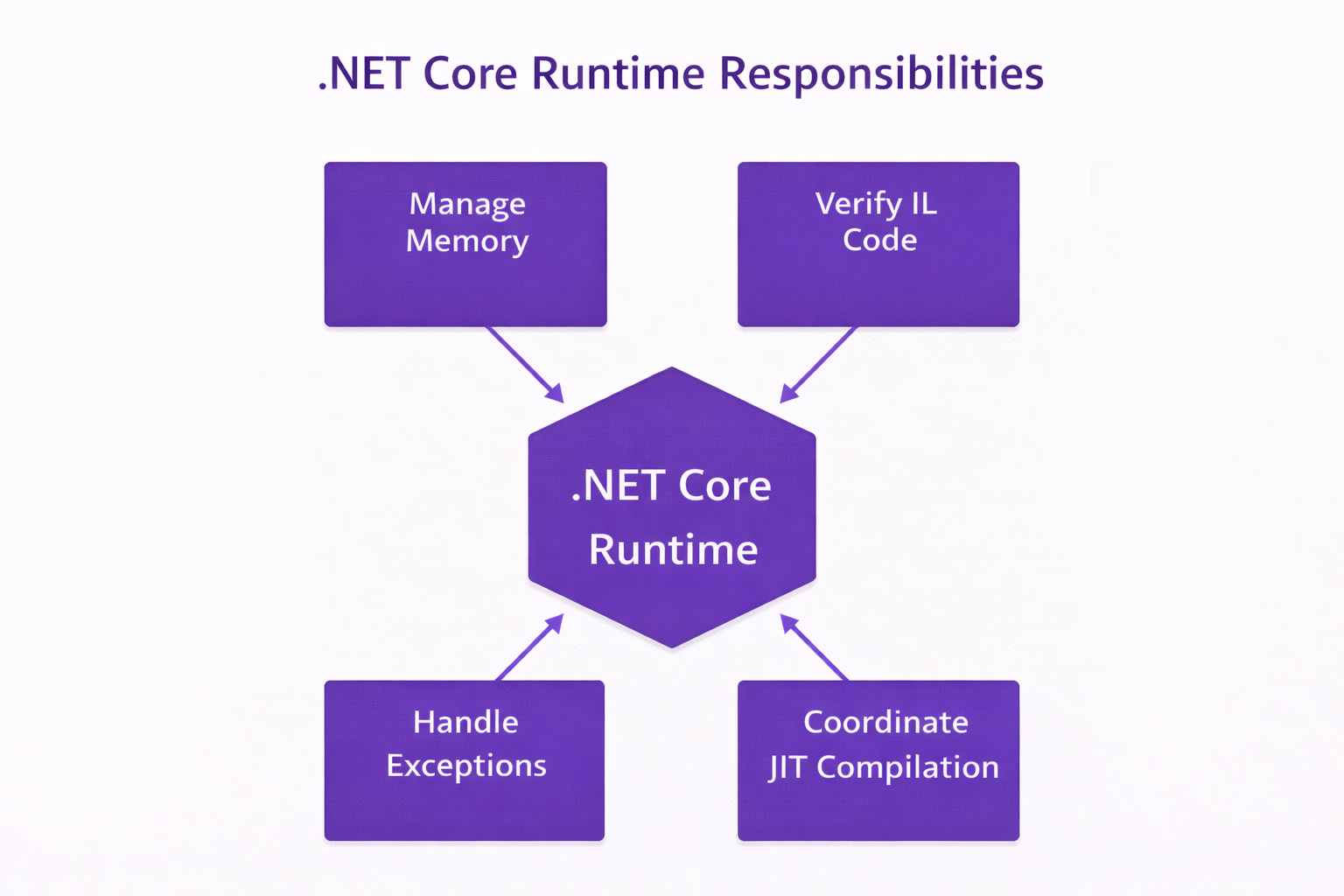
Key responsibilities include:- Loading assemblies
- Verifying IL code
- Managing execution flow
- Enforcing type safety
- Handling exceptions
- Coordinating memory management and JIT compilation
4. Intermediate Language (IL) and Assemblies
When a .NET Core application is built, the source code is compiled into Intermediate Language (IL) rather than native machine code.
IL is:- Platform-neutral
- CPU-independent
- Verified by the runtime before execution
5. Just-In-Time (JIT) Compiler
The JIT compiler translates IL into native machine instructions at runtime.
This approach allows the runtime to:- Optimize code for the current CPU
- Generate efficient execution paths
- Adapt to different hardware environments
Garbage Collection and Memory Management
.NET Core uses automatic memory management through a built-in Garbage Collector (GC).
The Garbage Collector:- Allocates memory automatically
- Tracks object lifetimes
- Frees unused memory
- Optimizes allocation patterns
Garbage Collection Generations
.NET Core uses three generations:- Generation 0 – short-lived objects
- Generation 1 – intermediate lifetime objects
- Generation 2 – long-lived objects (includes Large Object Heap)
This generational model improves performance by collecting short-lived objects frequently while minimizing expensive full collections.
Platform Abstraction Layer (PAL)
The Platform Abstraction Layer isolates operating system–specific behavior from the rest of the runtime.
PAL enables:- Cross-platform execution
- Consistent behavior across Windows, Linux, and macOS
- Container compatibility
System calls and OS-specific APIs are handled internally, allowing applications to remain platform-agnostic.
Hosting and Execution Model (Runtime Perspective)
At the .NET Core level, hosting refers to how the runtime starts and executes an application, not how HTTP requests are processed.
Characteristics:- Applications are self-hosted
- Runtime versions are isolated per app
- Multiple runtime versions can coexist safely
- Side-by-side deployments
- Safer upgrades
- Cloud and container-based execution
What .NET Core Architecture Explicitly Does Not Include
To avoid architectural confusion, it’s important to be explicit.
.NET Core architecture does not include:- Middleware
- Routing
- Controllers
- Dependency injection pipelines
- Logging frameworks
- HTTP request handling
Final Summary
.NET Core architecture defines how applications run, not how applications behave at the web or UI level. It provides the execution foundation that makes modern .NET fast, portable, and reliable.
By separating runtime concerns from application concerns, .NET Core enables scalable, maintainable systems across environments.