-
What Is .Net Core
-
.NET Core is not just a newer version—it represents a fundamental shift in how .NET applications are designed and delivered. .NET Core is Microsoft’s modern development platform used to build fast, scalable, and cross-platform applications. It allows developers to write code once using the same programming language—mainly C# and run it on Windows, Linux, and macOS.
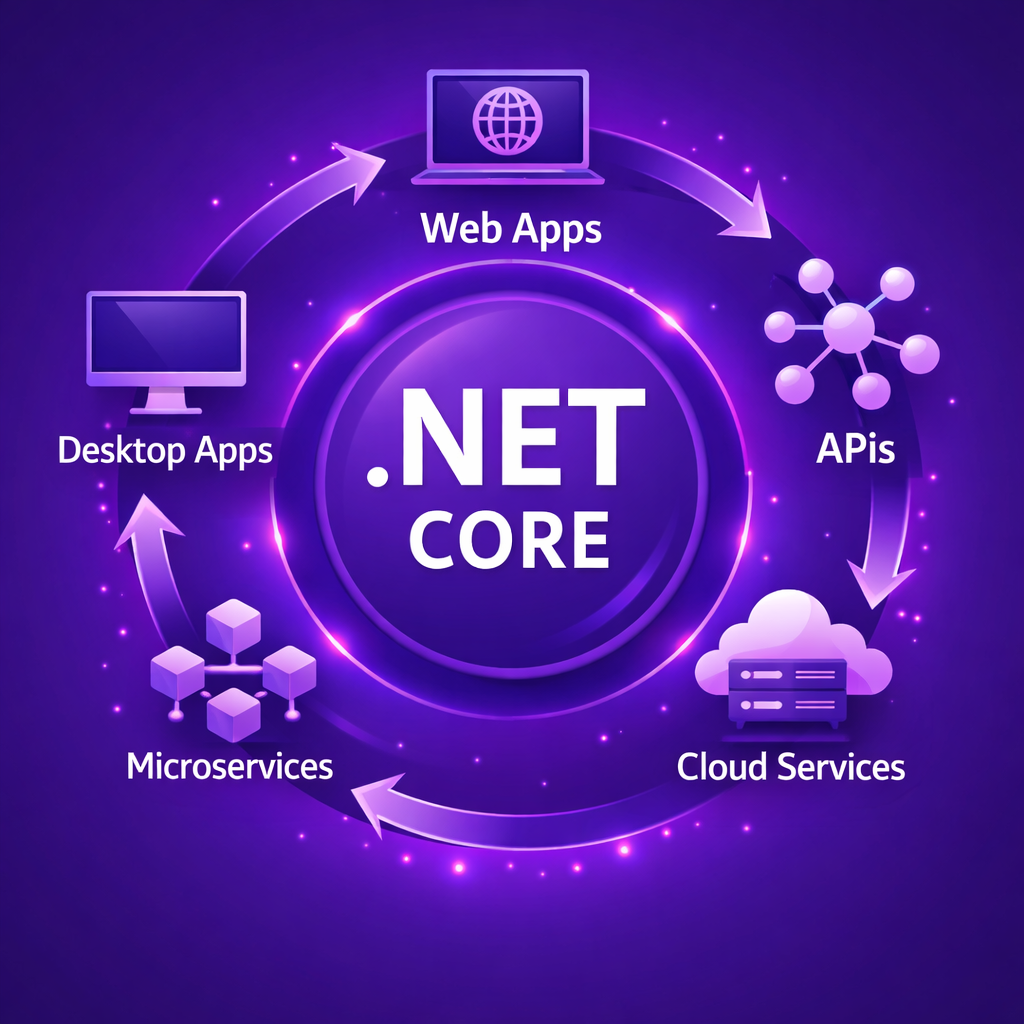
In simple words:
It is used to create:
.NET Core is the engine that powers today’s .NET applications.- Web applications
- REST APIs
- Desktop software
- Cloud services
- Microservices
Why .NET Core Exists?
Modern software no longer runs on just one machine or one operating system. Applications today must run in:- Cloud servers
- Linux containers
- Docker environments
- Kubernetes clusters
What Makes .NET Core Different?
.NET Core is not just an update — it is a new design philosophy.
One of the biggest philosophical changes in .NET Core is modularity. Rather than loading a huge framework for every application, .NET Core allows apps to include only the components they actually need. This results in:
- Smaller application size
- Faster startup time
- Better performance
- Fewer security risks
Another philosophical change in .Net Core is being platform-agnostic. Developers no longer need to rewrite or modify code for different environments. This philosophy aligns with DevOps, CI/CD pipelines, and cloud-native development.
In simple words, the changes in .Net Core makes it being:
- Cross-platform – works on Windows, Linux, macOS
- Open-source – developers worldwide can contribute
- High-performance – optimized for modern CPUs and servers
- Modular – apps load only what they need
How .NET Core Fits Different Application Architectures?
1. Monolithic Applications
.NET Core works extremely well for traditional monolithic applications, where all features are part of a single codebase.
In such setups:- The application is simple to deploy
- All logic lives in one project or solution
- Performance is optimized through a shared runtime
This makes .NET Core a strong choice for internal tools, admin panels, and medium-sized business applications
2. API-First and Headless Backends
.NET Core is widely used to build API-first systems, where the backend is completely separated from the frontend.
In this architecture:- .NET Core handles business logic and data access
- Frontend frameworks consume APIs
- Mobile apps and web apps share the same backend
3. Microservices-Based Systems
For large systems, .NET Core fits naturally into microservices architecture.
Each service:- Is small and focused
- Can be deployed independently
- Can run in containers
- Communicates over HTTP or messaging systems
4. Cloud-Native Applications
.NET Core is designed with cloud hosting in mind.
It supports:- Environment-based configuration
- Health checks
- Structured logging
- Horizontal scaling
5. Cross-Platform Desktop Solutions
.NET Core also supports cross-platform desktop development, allowing teams to share logic across Windows and non-Windows environments.
This reduces duplicated effort and keeps business logic consistent across different application types.
Example: Basic .NET Core Program
Here is a basic C# program running on .NET Core:
Output:using System; class Program { static void Main() { Console.WriteLine("Welcome to .NET Core"); } }
This exact program can run on:Welcome to .NET Core- Windows
- Linux
- macOS
How .NET Core Runs Your Code
When you write C# code in .NET Core:
- The .NET SDK compiles it
- The code is converted into intermediate language (IL)
- The .NET Runtime converts it into machine code
- Your application runs
Real-World Use Case
Imagine you build a web API using .NET Core.
You can:- Run it locally on Windows
- Deploy it to a Linux server
- Put it inside a Docker container
- Host it on Azure
That’s the power of .NET Core.
Final Thoughts
.NET Core is the foundation of modern .NET development. It gives developers the freedom to build applications that are fast, scalable, and cross-platform.
The real strength of .NET Core is not just what it can build, but how well it adapts to different architectural styles using the same runtime, tools, and language. This flexibility is what makes .NET Core suitable for both small projects and large enterprise systems.
If you want to create future-proof software using C#, learning .NET Core is the right place to start.