-
Intermediate Language in .Net Core
-
Intermediate Language (IL) is the foundational execution format of .NET. Before any application runs, source code is compiled into IL, allowing the runtime to optimize and execute it safely across platforms. Understanding IL helps developers see how managed applications achieve portability, safety, and performance without being tied to a specific operating system.
What Is Intermediate Language (IL)?
Intermediate Language (IL) is a low-level, CPU-independent instruction set generated when .NET source code is compiled. It acts as a bridge between high-level languages like C# and native machine code. IL includes executable instructions along with metadata that describes types, methods, and references, allowing the runtime to understand exactly how the application should behave.
Example
Consider this simple C# method:int Add(int a, int b) { return a + b; }When compiled, it is converted into IL instructions that conceptually perform the following steps:
- Load parameter a
- Load parameter b
- Add the values
- Return the result
Think of IL as a universal language that the .NET runtime can translate into hardware-specific instructions at execution time.
What IL Does?
Intermediate Language describes what the program should do, but not how a specific processor should execute it.
For example, IL may represent an operation like: “Load two values and add them.”
But it does NOT specify:- CPU registers
- Instruction sets
- Processor architecture
How IL and Machine code Work Together>
Think of it as a translation process:
- IL = universal language
- Machine code = local language
The JIT compiler acts as the translator.
When the application runs:- CLR loads IL
- JIT converts IL → machine code
- CPU executes it
Managed Code Concept
Code compiled into IL is known as managed code because it executes under the supervision of the .NET runtime rather than directly on the operating system.
The runtime manages:- Memory allocation
- Garbage collection
- Thread execution
- Exception handling
var user = new User();You never manually free this memory. The runtime tracks the object and releases it when no longer needed. This reduces memory leaks and improves stability, making managed applications safer than traditionally unmanaged programs.
IL Verification
Before executing IL, the runtime performs verification to ensure the code is safe and valid. This process checks type usage, stack behavior, and instruction correctness to prevent unsafe operations.
Example:object value = "Hello"; int number = (int)value;This compiles, but at runtime the system detects the invalid cast and throws an exception instead of allowing memory corruption.
IL verification protects applications from crashes and security risks by ensuring only well-formed code executes.
C# compilation and execution flowchart
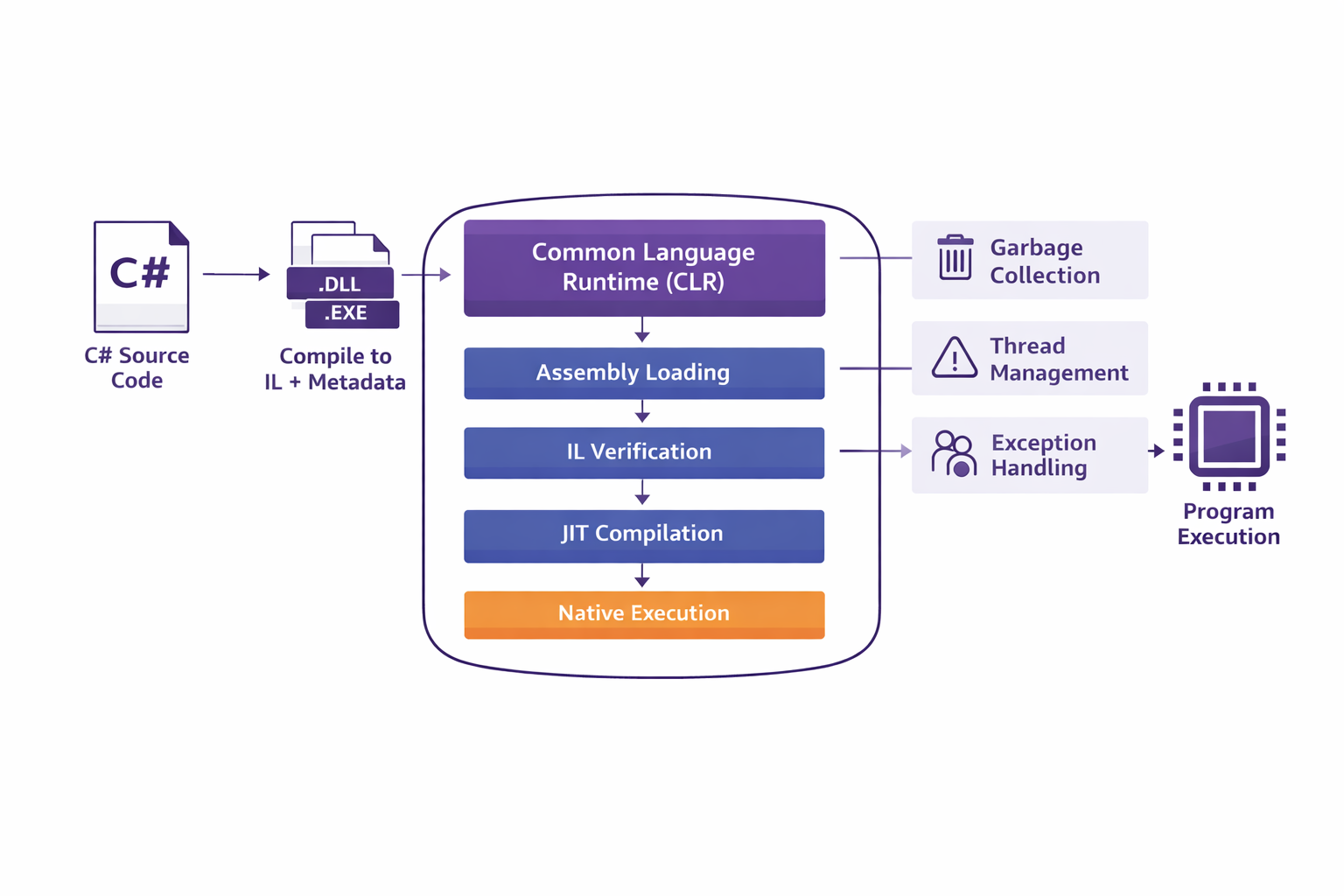
The diagram illustrates how C# source code is compiled into an assembly containing Intermediate Language (IL) and metadata, which is then loaded by the Common Language Runtime (CLR) for execution. Inside the CLR, services such as IL verification, JIT compilation, garbage collection, thread management, and exception handling work together to convert IL into native machine code and execute it safely and efficiently.
Final Summary
Intermediate Language (IL) acts as the critical bridge between developer-written code and the runtime execution environment. By compiling applications into a platform-neutral instruction set, .NET enables the same codebase to run across multiple operating systems and hardware architectures without modification.
This layered execution model allows the runtime to apply hardware-specific optimizations, enforce type safety, and maintain execution reliability, ensuring that applications achieve both portability and high performance.